 Dutch
Dutch
 English
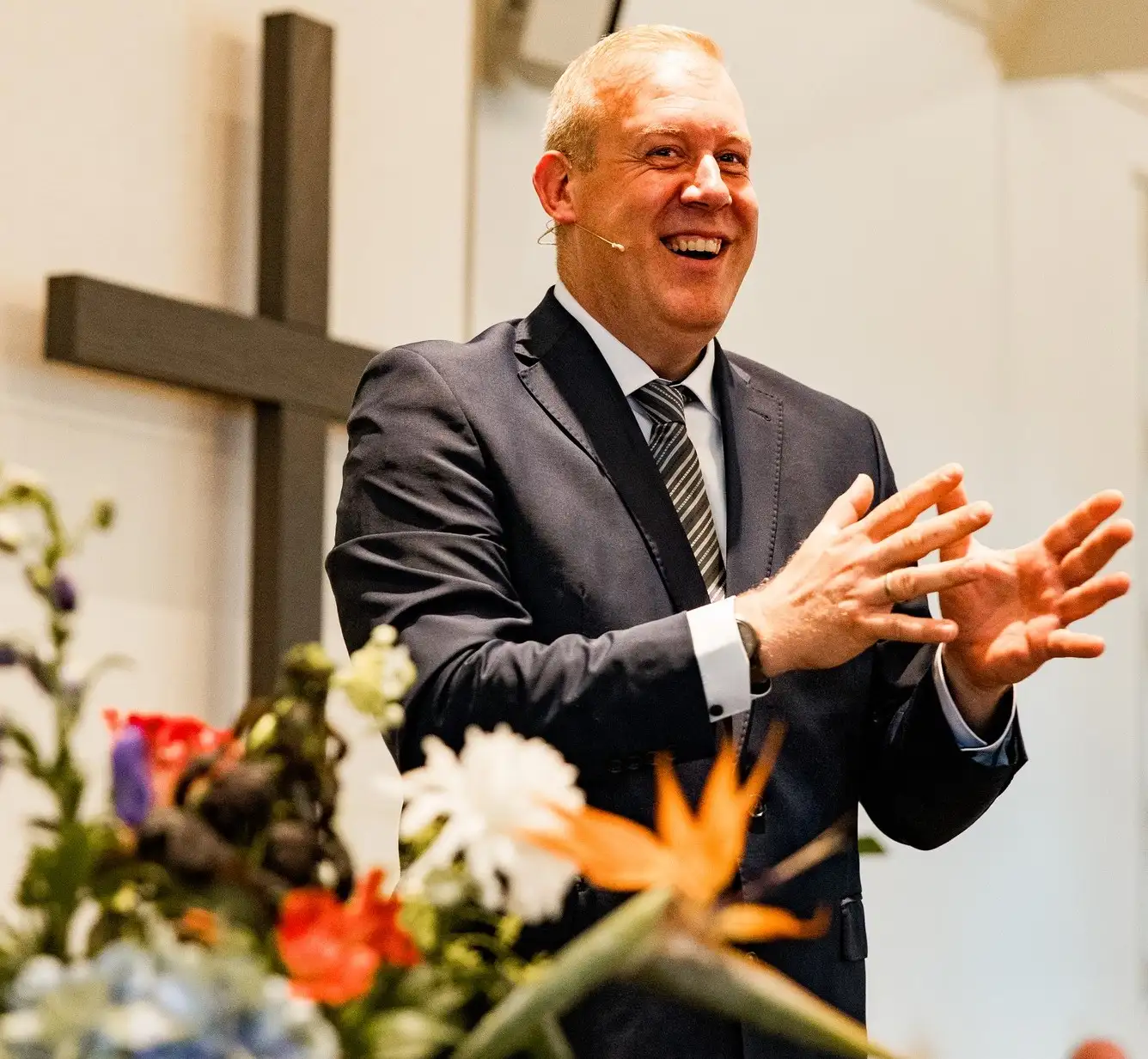
Already in grade 6 of primary school, Wietse van der Hoek knows he wants to become a teacher. After finishing teacher training, he quickly finds a job in education. He works there for several years, until one day a series of very coincidental events happens. Is it God speaking? Wietse radically changes his career and continues to learn much from God afterward. He shares his story with us.
We are warmly welcomed in the building of the Free Evangelical Church in Oldebroek. Wietse himself opens the door and guides us through the church. Along the way, he chats briefly with a church member who is hanging up crafts made by the children for Sunday’s service. When we arrive in the consistory room, he asks: “Fancy a coffee?” Moments later we are ready for the conversation.
Wietse’s Youth
Wietse was born in Dordrecht and grew up in a warm Christian family. He enjoyed going to church and became part of a lively youth group. As a teenager he learned to play the organ and often played in church. At fifteen, he was even given a church key so he could practice. After primary school he went to secondary school (havo) and then on to teacher training. Afterward, he considered studying theology, but the entry requirements still demanded much work. He decided not to continue studying, but to start teaching instead.
His first job was in education, at a disadvantaged school. There he encountered a lot of poverty and problems. In this period he learned much. He discovered that wherever your feet are in the mud, Jesus wants to be near! According to Wietse, God is a God of patience and time. Sometimes God does radical things, but often it is a process in which He walks a path with people.
Are You Calling Me?
In October 2005 Wietse marries Wendy. Wendy did not grow up with faith, but came to believe during an Alpha Course. Only a few months into their marriage, Wietse feels called to take a new step in life. At that time, he is conductor of a choir in Rotterdam. During a rehearsal evening, a choir member—who is also an elder in the church—hands him a flyer. It’s an invitation to an open day at the Baptist Seminary (which offers training for future theologians and pastors). The man tells him: “This is really for you, you should do something with it.”
It doesn’t mean much to Wietse. He stuffs the flyer into his inner pocket and continues with the evening. But during the break, someone else approaches him with the same flyer. “This is really for you, you should do something with it.” Again, it doesn’t make much of an impression.
That evening he goes back home in Dordrecht. He and his wife live in a house next to the church. In exchange for living there, they serve as caretakers: cleaning the church and locking up after meetings. From home, Wietse hears a meeting finishing in the church. Chairs scrape, voices fade. He goes in to lock up. An elder walks up to him—and for the third time that day hands him the same flyer! “This is really for you, you should do something with it.” What should he make of this? Back home, he wants to tell his wife. Wendy, already in bed, turns over and says matter-of-factly: “Just sign up tomorrow.” And then it clicks for Wietse. “Are You calling me?” he asks God.
Wietse attends the open day and registers for the ETH theology bridging program, one of the Baptist Seminary’s courses. Later he shares this testimony with the choir. The men who had given him the flyer had not known about each other.
Even before his studies begin, a church in Rotterdam asks if they may appoint him. He can do his internship there, and afterward he becomes pastor. This becomes his first congregation.
Whom Do You Serve: People or Me?
Wietse still remembers it well: he is standing at the metro station, looking out over the Rotterdam skyline. All those lights at the oil refinery, so beautiful! The platform is empty. He thinks of his congregation, with its different people and different opinions. He longs to keep everyone happy, but finds little satisfaction in that. And there on the platform, a question comes into his mind: “Who are you serving? When will you serve Me instead of people?”
It is not an audible voice, but a thought that stays with him. Still, he knows it comes from God. The question makes him think deeply. Soon afterward, he is asked to play piano at a conference in Ede. Though he comes to make music, the message moves him. It is about the five solas: by faith alone, by grace alone, by Scripture alone, Christ alone, and glory to God alone. What Wietse could not put into words is explained there. It is not about people, but about God alone. With this in mind, he wants to continue as a pastor. He even calls this his second conversion. After this, he notices more joy in himself and sees positive changes in the church.
Conclusion
In his ministry, Wietse often asks himself whether he is busier with the work of the Lord than with the Lord of the work. For him, it is important to recharge so he doesn’t run dry. He tries to start the day with God: his quiet time. He does this in the morning, though for someone else it may work better in the evening.
Quiet time is not, for him, just a box to tick, but being together with Him. From there he involves Jesus in his work and visits—but also takes Him along to sports or a birthday. Wietse shares his life with Jesus, wherever he goes.
Share Geroepen voor het werk van de Heer?
or copy the link